
ORIGINAL STUDY RECORD · PUBLISHED 9 OCT 2026
The hardware work behind the companion.
This record draws on 李冠志’s 13-slide presentation, 智能對話機 自主學習 - 1改, supplied on 9 October 2026. The original file does not establish an exact build date. This publication date is not a company incorporation date.
The builder documented physical assembly, soldering, firmware deployment and a reported conversation test using Xiaozhi. The photographs show parts of that work. They do not independently establish present-day operation, Claude integration or measured performance.
Hardware assembly
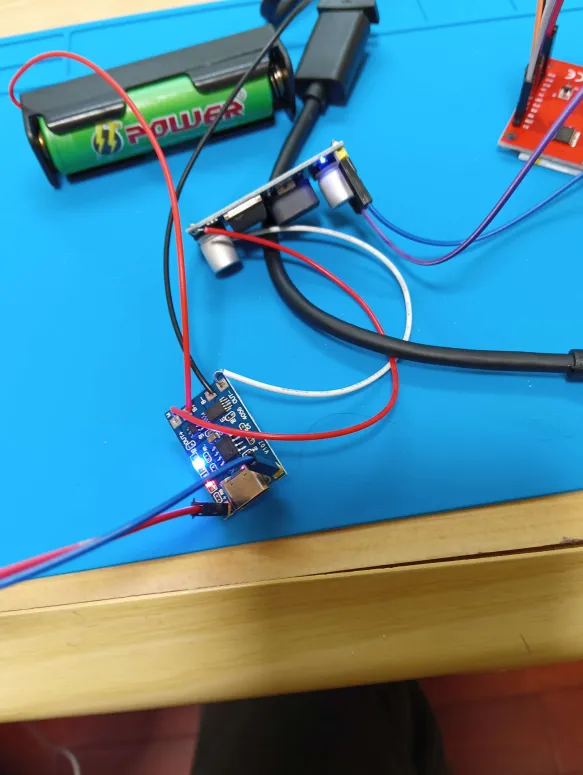
Slides 5–8 document an ESP32-S3 board, an INMP441 I²S microphone, SPI display wiring, an audio amplifier and speaker, plus an 18650 battery and TP4056 charging-module experiment. The historical microphone is I²S. A USB microphone would be a separate hardware revision.

The builder’s contribution
- Selected and acquired components, then connected the microphone, display and audio modules.
- Used a breadboard to hold microphone header pins during soldering.
- Desoldered amplifier leads and described replacing them with headers for easier connections.
- Explored battery and charging-module wiring.
- Prepared the ESP-IDF and VS Code environment, flashed firmware and configured Wi-Fi and device binding.
The report explicitly says the builder did not modify the original source code. This was hardware and system-integration learning using existing open-source firmware.
Debugging lessons
Slide 10 records two flashing problems: a USB cable that supplied power without data, and a flashing rate that was too high for the setup. These are concrete deployment lessons. The exact firmware commit, flash settings and logs were not included in the supplied report.
Conversation loop and upstream work
Slides 3 and 10 report testing voice input, a cloud AI response and spoken playback. Slides 11–12 analyze Xiaozhi’s speech services, cloud models and WebSocket communication. These architecture descriptions should not be read as proof that every discussed provider was configured on this particular device.
Earlier work used 78/xiaozhi-esp32. Credit for the upstream firmware belongs to its contributors. The report does not document Claude use.
What needs to be checked next
- Check the actual current board, display, audio modules and wiring against a component list.
- Review the historical power circuit. The report’s voltage claims are not backed by measurements here and are not instructions for reproducing a safe battery-powered design.
- Record the firmware version and a fresh hardware conversation demonstration.
- Implement and evaluate the proposed Claude backend separately.
The report’s future suggestion of a smaller “offline AI assistant” is an ambition. The described language-model conversation relies on cloud services.
EdgeTalk Labs aims to build an expressive physical companion on this learning foundation. A proposed Claude integration specification defines the next milestone. It has not yet been deployed.